

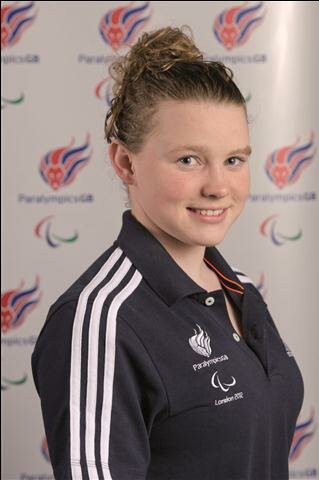
Swimming champion, Gemma Almond, tells us how university life is now she’s qualified for the 2012 Summer Paralympics.
With the 100 day countdown to the London 2012 Olympics beginning and the Welsh Varsity around the corner, Swansea University is proud to see sporting students on a journey to success.
Hoping to win medals is 19-year-old Gemma Almond, (pictured left and training, above) above a first time Paralympics swimmer studying History at Swansea University.
Gemma qualified at the March British Championships in the 200m Individual Medley. As a bonus to this, she set a new British Record for this category and continued to smash records at second trials in Sheffield for the 100m Butterly in the same category.
Gemma has bilateral hip dysplasia, meaning that she does not have a fully formed hip joint on both sides and therefore has no support for weight bearing on her legs. This causes reduced leg strength and range of movement which is a minor mobility disability.
“I am feeling very excited about the Paralympics. It’s great it is so close to home, as all my family have tickets and can come down and watch me compete.
“I’ve been swimming since I was four – I did hydrotherapy following one of my four major operations I had. From here, I loved being in the water as it was a non-weight bearing activity, as weight is what hurts my legs because having no hip joint means I have limited weight bearing support.
“My sister is four years older than me and was swimming competitively from 9, so it was natural to follow her and I really enjoyed it. I started competing from the age of 6 and since, have won medals worldwide at smaller international heats and bronze at the 2011 IPC European Championships in Berlin, Germany which I am most proud of.”
Gemma’s dream of competing in Team GB for the Paralympics has only risen over recent years.
To become a Paralympian, the competitor has to first be classified into a category from S10-S1(S1 being the most severe) S13-11 visual impairment and S14 learning difficulties.
In these, there are 3 categories for different strokes: ‘S’ is freestyle, backstroke and fly, ‘SM’ is individual medley and ‘SB’ is breastroke.
“I wasn’t classified until I was 14-years-old and then was placed on the development programme for Great Britain.
I now compete in S10, SM10 and SB9, so in the least physically impaired categories.
“My disability doesn’t tend to affect my daily life at university too much. As a first year, I am living on campus, so walking is minimal and I tend not to struggle too much.
“Next year, I will have to buy a car to transport myself around and to the Swansea HPC for training, but apart from that, I lead a relatively balanced, student life.”
Representing their country can exert quite a pressure on competitors, especially from the media. As higher profile competitors have experienced, their faces will become as symbol of hope for their sport and fans. With the 2012 Paralympics being her first, Gemma is yet to feel this pressure:
“The media has no real expectations of me yet, so I’m kept pretty low under the radar.
“I don’t really tell people that my swimming career is a big as it is! I just say ‘sorry I’ve got training’ if I cannot make an outing with my friends. I think it’s quite boastful to go around saying I’m in Team GB. My friends tend to joke I go to swimming for leisure!
“I live on a floor with all 1st year swimmers which is so helpful for my university experience. So, we are all always really busy at university, swimming or eating together, which is great to have people in the same position as me.
“In some ways, we do miss out on the typical university experience. We know most students go out a few times a week, whereas we can only really let our hair down once every couple of months.
“However, we have found a good balance and are really enjoying being in Swansea.”
First time competitors can look up to those who have preceded them for inspiration. With the Olympics motto being “Inspiring a generation”, Gemma shares how working as a team inspires her to succeed at the Summer Paralympics:
“I don’t have anyone in particular, but I look up to so many Olympic swimmers. I am lucky to train with Ellie Simmons…. And together, we inspire each other and push each other along.
“It is going to be tough to get medals, as having only just moved to Swansea, I am still getting used to training. The Rio 2016 Olympics is my ultimate goal.
Gemma trains over 20 hours a week, including both gym and water, but knows that it will pay off:
“After the hours of training we put in, it is so rewarding when you succeed.
“My advice to anyone thinking of competing in sports, is never give up. Always put 100% in to everything you do and you will too succeed.”
The Paralympics run from the August 29 to September 9 2012.
Comment Below (Moderated)
comments