

Issue 150
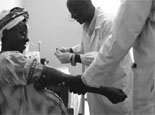
Antiretroviral drugs are slow to reach many parts of Africa
A Crash Course in... AIDS
04th December 2006
Acquired Immune Deficiency Syndrome, commonly known as AIDS, is a retrovirus that kills its host by weakening and eventually destroying the body's immune system. It spreads through the mixing of bodily fluids, such as blood, semen, vaginal secretions and breast milk. As a result, the principal means of spread for the disease is through unprotected sex.
HIV (Human Immunodeficiency Virus), the viral state of the disease, will normally take about 9 to 10 years to develop into AIDS. This can be extended through the use of antiretroviral drugs, but once the HIV develops into AIDS survival time is normally guaranteed within 9 months from this point, depending upon the strength of the victim's immune system. During this period of time the body's immune system slowly collapses, resulting in the victim succumbing to illnesses that they would normally be able to fight off.
Once someone is infected with HIV it normally takes about three months for the virus to show up in any tests. This is hindered by the fact that the victim will feel in perfect health in the early stages, and most likely be unaware that they have the disease.
At this point in time there is no cure for either HIV or AIDS, and since it was first recognised in 1981, The World Health Organisation (WHO) estimates that approximately 25 million people have died of the disease worldwide, and that about 40 million are infected.
Some 60% of all infected people worldwide are from sub - Saharan Africa, where education into the causes of the disease is rare, screening poor, and the supply of life prolonging antiretroviral drugs inadequate. As a result life expectancy in this region of the world is the lower than anywhere else - in Zimbabwe life expectancy is down to 39, lower than any other country. The US census bureau estimates that by the year 2010 Africa will have 71 million fewer people through the direct or indirect results of AIDS.
Some common misconceptions about AIDS are that only homosexuals or drug users can get it, that it can be caught from toilet seats, from food prepared by an infected person, through holding hands or hugging, or that sex with a virgin will cure it. The only way not to die of AIDS is not to catch it in the first place, which can be ensured with due care. The most obvious and effective method is to use a condom during sex or some other barrier method, and to take precautions around spilt blood or when administering first aid. Free Condoms are available from the Sabb's office on the third floor of the student union - just go and speak to the welfare officer, Miles.
Dan Shaw
 Dan Shaw
International Editor
Dan Shaw is the International editor, covering all the current events across the globe.