

Issue 147
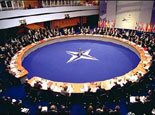
The 2002 NATO Summit in Prague
A crash course in... NATO
23rd October 2006
The North Atlantic Treaty Organisation (or NATO) is a political and military alliance of 26 countries from Europe and North America based around the principle of mutual security and is a key player in contemporary international relations.
Formed in 1949 as a result of perceived Soviet expansionism and empire building, its fundamental role is to "safeguard the freedom and security of its member countries by political and military means." Informally, however, its role is described as a way to "keep the Russians out, the Americans in and the Germans down."
With the formation of the Warsaw Pact, a military alliance formed by the Soviets in 1955, and the beginning of the cold war, NATO entered a decades long period of brinkmanship over Europe and was instrumental in maintaining the balance of power.
With the end of the Cold War in 1991 and a lack of a military threat since the demise of communism the future of NATO appeared to be in doubt. However, the Gulf war of 1991 proved that the world was still a very unstable place and that the military alliance still had a future and was a necessary factor in providing stability for the world.
Despite the tensions of the Cold War, NATO forces thankfully never saw action until 1999 when Serbian forces began ethnically cleansing Kosovo. Despite not having a mandate from the UN Security Council, NATO forces took unilateral action and successfully ended the crisis, resulting in Serbian leader Slobodan Milosevic being tried for crimes against humanity at the international tribunal at the Hague. However no verdict could be reached before Milosevic's death in 2005.
Kosovo was, however, a dramatic demonstration to the world of the power of NATO. Ninety percent of the weapons dropped were precision munitions, allowing an unprecidented level of accuracy, although some problems were encountered with laser guided bombs in thick cloud.
After the attacks on the USA on 11 September 2001, Article 5 of the NATO mandate was enacted for the first time. Article 5 is the cornerstone of the alliance, which states that any attack on one state is considered to be an attack on all of the states in the alliance.
As a result, NATO forces saw action again in Afghanistan fighting the Taliban government, eventually forcing them from power. Some years later, however, NATO is still engaged against a resurgent Taliban, strengthened by US and British forces being siphoned off to fight in Iraq. NATO, however, has no position on Iraq - despite the fact that many countries involved are from NATO, it is not a NATO action.
Dan Shaw
 Dan Shaw
International Editor
Dan Shaw is the International editor, covering all the current events across the globe.