

Issue 152
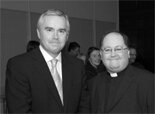
BBC Chief News Presenter Huw Edwards
Huw Edwards delivers lecture
12th February 2007
Friday 26 January saw the BBC's chief news presenter Huw Edwards give this semester's first theology lecture entitled 'Listening to the Viewer'.
The Llangennech-raised broadcaster spoke about many issues relating to the BBC's audience and its opinions on the news. Huw first spoke about news broadcasting channels losing much of their 16-25 year old audience, commenting that the last five years have seen at least a 110 per cent fall in these young viewers watching the news.
Huw said that: "If you are taking a licence fee from every house in the country, you want to please as many people as possible". With this mind, Huw had several ideas about how news channels and the BBC in particular can be more effective in attracting younger viewers.
One possible solution is for the BBC to be more active in schools, encouraging younger children and teenagers to recognise the importance of listening to the news, whether this is done through conventional news watching on television or reading it in newspapers, by sending it to mobile phones in the form of text messages, or publicising the BBC's website.
Huw stated that the BBC website and viewers being able to tailor make their own version according to where they live, like BBC Wales is "hugely popular" and "a great facility to have." He went on to say that this important local platform is "often overlooked" and "what is relevant to viewers is key."
Huw stressed that the BBC recognised the importance of the audience having an opinion, and 'The Pulse' was created with this in mind. 'The Pulse' is a BBC programme, with an accompanying website, dedicated to gathering viewers opinions on news bulletins. Over 5000 people log on every day and give their views on the bulletins they are asked on. Every group in society is included and represented, children and the elderly alike.
Huw went on to comment that the results showed that crime, law and order and health policy were the most important issues to viewers and topped the list. These topics are less popular if the stories about them are told in the 'wrong way', or if the bulletins are not strictly relevant to viewers. A bulletin on climate change in China is not so relevant to British viewers as a bulletin about climate change in Britain for example.
Similarly, news stories which the BBC think viewers will definitely be interested in are not popular at all. Just one per cent rated Madonna adopting a child from Malawi as being a story worth telling. Viewers are more concerned about bulletins covering the green agenda.
Huw said that the way in which news stories are presented and told also affects their popularity, commenting that giving people the main information and "making them hang on to watch it" in 20 seconds is "one of the main challenges of news writers in television."
Costing just 36 pence a day, and attracting an audience of which 85 per cent trust the BBC over and above every other news channel, Huw believes that the BBC is at the forefront of news telling.
The Reverend Nigel John, Anglican Chaplain at Swansea University, who organised the lecture, said that: "Huw once again demonstrated that he is a master in the art of communication. His talk was informative, inspiring and challenging. He is precisely how I remember him in school, bright, warm, engaging, funny and kind."
The £5 admission charge for each person raised a total of £1,200 on the night, with all of the proceeds going to ward seven at Singleton Hospital for the care and rehabilitation of stroke patients.
Caroline Sutch
 Caroline Sutch
News Editor